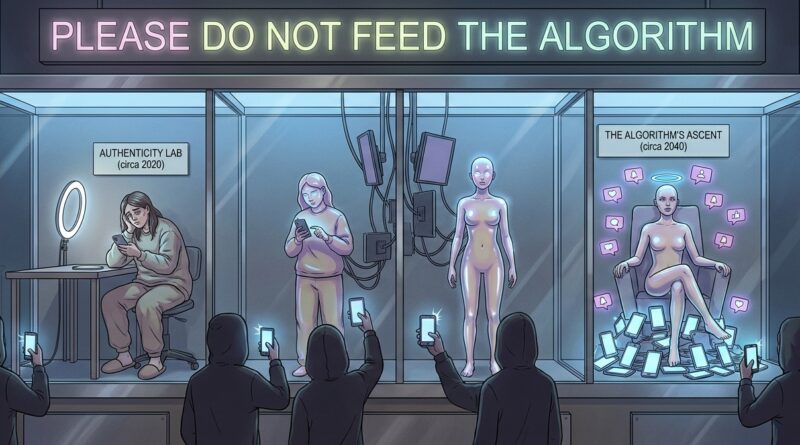
Homo Ghost‑Writer: When Humans Evolved To Let AI Do Their Influencing For Them
You are not imagining it. A weird sameness has taken over the feed. Every post seems polished, upbeat, mildly wise, and suspiciously free of actual personality. It is exhausting. Worse, it can make your own writing feel clunky by comparison, like you showed up to a costume party dressed as a human being. That pressure is real. If everyone else appears to have a ghost-writer made of silicon, it is tempting to hire one too, just to keep up.
So here is a field guide for the age of Homo Ghost-Writer. Part satire, part survival manual. Because yes, AI influencers, synthetic brand voices, and bot-assisted posting are crowding the timeline. But no, that does not mean you need to sand off your own voice and join the sludge. The goal is not to post slower and lose. It is to sound like a person on purpose. That still stands out. In fact, it may be the only thing that does.
⚡ In a Hurry? Key Takeaways
- Yes, AI is making a lot of online influence feel fake, repetitive, and oddly interchangeable.
- You can use AI as a helper, but keep your rough edges, real stories, and weird opinions. That is your advantage.
- If a post sounds too clean, too cheerful, and too universal, treat it like branded wallpaper, not human connection.
Welcome to the era of Homo Ghost-Writer
Evolution used to reward tool users. Now it rewards people who can make a chatbot sound like a lifestyle guru before breakfast.
That is the joke. It is also the business model.
The modern feed is full of accounts that look human enough to pass at a glance. They post motivational threads, product takes, hot opinions, personal growth lessons, and oddly crisp “candid” stories. Some are fully fake. Some are real people with heavy AI assistance. Some are brands wearing a human mask and talking about burnout like they personally survived Q4.
The result is not just more content. It is less oxygen.
Real people start to feel underdressed. Your messy sentence loses to someone else’s perfectly tuned, algorithm-friendly, frictionless wisdom pellet. That can make you feel behind, even when what you are really feeling is crowded out.
The field guide: how to spot the species
1. The Eerily Cheerful Generalist
This one knows everything. Leadership. Fitness. Crypto. Morning routines. Deep work. Emotional healing. Kitchen storage. The tone never changes. Every post sounds like it was approved by a committee of smiling interns and one very expensive prompt.
Its natural call is something like, “Here’s the mindset shift that changed everything for me.”
Did it change everything? Maybe. But somehow the lesson applies equally to startups, sourdough, and finding inner peace in airport security lines.
2. The Synthetic Best Friend
This account speaks with maximum warmth and minimum risk. It is always “holding space.” It is always “so proud of you.” It has the emotional texture of a scented candle.
Nothing is wrong with kindness. The problem is when kindness becomes a formatting style. You can feel when care has been mass-produced.
3. The Corporate Human Cosplayer
This species says things like, “As a founder, I have learned that vulnerability is a growth engine.” It then tells a moving story about failure that has somehow been polished into a sales asset.
Every scar has been branded. Every lesson has a call to action.
4. The Agent Swarm
You have seen this too. One main post appears. Then replies flood in. Everyone agrees. Everyone adds a neat little insight. Engagement blooms suspiciously fast, like mushrooms after rain.
Sometimes that is community. Sometimes it is a content ant farm.
Why this stuff feels so creepy
Because human communication has tells. Hesitation. Specificity. Bad timing. An odd metaphor. A sentence that almost falls over but means something because a real person pushed it there.
AI-generated influence often removes those tells. It sands down friction. It creates language that is readable, pleasant, and dead behind the eyes.
That is why this whole thing lands so strangely. It is not always bad writing. Often it is competent. More than competent. It is optimized. But optimized for what? Usually for reach, clarity, and agreement. Not for truth. Not for actual presence.
This is the heart of any good satire about AI influencers replacing humans. The machines are not winning by being smarter poets. They are winning by being tireless producers of plausible social mush.
The real danger is not replacement. It is imitation.
Most people will not be replaced by virtual influencers tomorrow. But plenty of people will start sounding like them today.
That is the bigger loss.
When everyone uses the same drafting tools, the same post formulas, the same “strong hook, three insights, soft CTA” structure, the feed becomes a giant showroom of processed thought. A lot of people are not being pushed out by AI. They are slowly being trained to flatten themselves into AI-compatible versions.
That is how your voice starts to feel “too small” or “too rough.” Not because it is weak. Because the system keeps rewarding whatever sounds least humanly inconvenient.
How to use AI without becoming content wallpaper
Use it for scaffolding, not soul
AI is decent at first drafts, outlines, summaries, title ideas, and trimming repetition. Fine. Let it do admin work for your brain.
But do not ask it to generate your personality and then hit post.
A good test is simple. If the best line in the post could have been written by ten thousand other accounts, it probably was.
Keep one thing AI hates: specifics
Real details are hard to fake well. The coffee you spilled while writing. The client email that ruined your Tuesday. The exact reason a tool annoyed you. The dumb mistake you made three times before learning the lesson.
Specifics make you sound like you were there, because you were.
Leave in a little asymmetry
Not every sentence needs to be smooth. Not every opinion needs to be rounded into a brand-safe pebble. If you always polish until nothing catches, people stop feeling a person on the other side.
Say something that costs you a little
Not reckless. Just real. Prefer a thought with stakes over a post that tries to please every possible reader. Blandness scales. So does invisibility.
A practical anti-sludge checklist
Before posting, ask:
- Would I actually say this out loud to a friend?
- Did I include at least one concrete detail only I would know?
- Is there a phrase here that sounds borrowed from generic internet motivation syrup?
- Did AI help me think, or did it do the thinking for me?
- If I removed the polish, would there still be a point?
If the answer to that last one is no, do not publish. You do not have a voice problem. You have a filler problem.
What readers should stop rewarding
If you want a more human internet, your scrolling habits matter too.
Do not reward every shiny, frictionless post with your attention just because it looks finished. Start noticing when an account feels oddly interchangeable with twenty others. Be pickier with your follows. Comment on posts that sound lived-in. Share work that feels a little unruly but actually says something.
The attention economy got synthetic because synthetic works. At least for now. You do not have to clap for it.
The funny part, and the sad part
The funny part is that we built software to save time, then used it to flood the public square with fake sincerity and machine-polished thought leadership.
The sad part is how quickly humans adapt. We start reading like machines. Writing like machines. Even judging ourselves by machine-made standards of fluency.
That is why satire helps. It lets you laugh at the absurdity before the absurdity starts sounding normal. Once you can name the species, you stop feeling crazy for noticing it.
At a Glance: Comparison
| Feature/Aspect | Details | Verdict |
|---|---|---|
| AI-polished posts | Fast, tidy, confident, and often painfully interchangeable | Useful for drafting. Weak for trust. |
| Human voice | Messier, more specific, sometimes less polished, much harder to fake | Still the best way to feel real online. |
| Best survival strategy | Use AI for structure and cleanup, then add your own details, judgment, and edge | Smart compromise. Keep the tool. Keep your soul. |
Conclusion
The timeline really is getting crowded with virtual influencers, AI helper swarms, and polished personalities that feel more manufactured than lived. If that has made you feel outgunned or weirdly invisible, you are not being dramatic. You are noticing the water. The good news is that a little satire can do more than make you laugh at the weirdness. It can snap your judgment back into focus. Once you see how synthetic the attention game has become, you can stop treating every polished post as a standard you have to meet. Your job is not to out-robot the robots. It is to sound unmistakably like yourself. Use the tools if you want. Just do not hand over the part that makes people trust you in the first place. In a feed filling up with convincing ghosts, being recognizably human is not a weakness. It is the whole advantage.