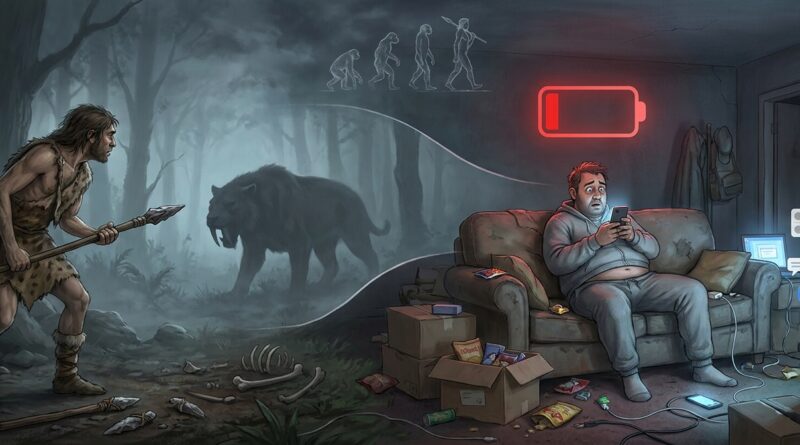
Homo Comfort‑Maximus: When Humans Evolved To Fear Low‑Tech Days More Than Saber‑Tooth Tigers
You are not weak because a dead phone battery makes you feel oddly panicked. It is irritating, a little embarrassing, and also very normal. One part of your brain still thinks like a creature scanning the horizon for danger. The other part thinks your two-factor login code is the difference between survival and ruin. So when the Wi-Fi drops for fifteen minutes, your body reacts like the village wall just fell down. That is the joke at the center of modern life. We talk big about how we could totally handle the wilderness, right up until the map app will not load and suddenly crossing town feels like crossing the Arctic. The truth is not that ancient life was better, or that modern tech is bad. It is that our bodies and our tools are living in different centuries, and that gap can make very small inconveniences feel weirdly huge.
⚡ In a Hurry? Key Takeaways
- Humans are not built wrong. We are just using ancient threat systems inside a very high-tech life.
- Try one small low-tech drill each day, like a 15-minute walk without your phone or doing one task from memory.
- The goal is not to reject technology. It is to stop every tiny tech failure from feeling like a personal apocalypse.
Welcome to Homo Comfort-Maximus
This species looks a lot like regular humans, except it becomes spiritually unwell when the charging cable is in the other room.
We have climate control, grocery delivery, waterproof shoes, and little glass rectangles that can summon a taxi, a date, or the answer to “who was that actor from that thing.” And yet many of us feel one software hiccup away from turning into Victorian ghosts.
That sounds silly. It is silly. But it is also real.
The current internet argument loves two extremes. One side posts dreamy cave-and-campfire content and talks as if our ancestors spent all day barefoot, glowing with purpose, and gently fermenting roots. The other side treats every new gadget like it is the final step in human evolution. Most of us live somewhere in the middle, where back pain, calendar alerts, and food delivery coexist in an uneasy mix.
Why a Router Problem Feels Like a Wolf Attack
Your nervous system does not do nuance very well. It is excellent at one thing. Spotting change and asking, “Should I worry?”
For most of human history, surprise often did mean danger. A strange sound in the bushes could be bad news. Losing track of your group could be bad news. Not knowing where the water was could be very bad news.
Now the “danger” might be a spinning loading icon before a work call.
Logically, you know the difference. Biologically, your body still hates uncertainty, interruption, and loss of control. So when your maps fail, your battery dies, or your password manager decides today is a day for character building, your system can react with outsized stress.
Not because you are spoiled beyond repair. Because old wiring is now connected to new annoyances.
The Great Modern Comedy
Your body says hunt
Your body likes movement, sunlight, rhythm, effort, and paying attention to the physical world.
Your calendar says join at 3:30
Your day is full of pings, tabs, passwords, receipts, tracking numbers, and requests to update something that was working yesterday.
This is where the satire hunter gatherer vs modern technology debate gets interesting. The funny part is not that one era was pure and the other is broken. The funny part is that we are carrying Stone Age alarm hardware through a software-heavy life that keeps creating tiny fake emergencies.
That mismatch is exhausting.
No, You Probably Would Not Thrive in the Woods
Let us be honest with each other. Many people who fantasize about escaping modern life would be defeated by one wet log and a missing lighter.
That is not an insult. I include myself.
The hunter-gatherer daydream usually skips over infection, injury, hunger, weather, and the fact that “organic lifestyle” sounds better when it is not being interrupted by a parasite.
At the same time, modern comfort has made us fragile in oddly specific ways. We can order Thai food from bed, but some of us cannot remember a single phone number. We can stream a documentary about resilience while getting upset that the app asked us to log in again.
So the answer is not pretending we should all become wilderness influencers. The answer is noticing where convenience has turned into dependency.
The Small Low-Tech Drill That Actually Helps
Here is the practical part. Do one short, low-tech thing every day on purpose.
Not as punishment. Not as a productivity stunt. Just as a way to remind your brain that inconvenience is not the end of civilization.
Try the 15-minute friction drill
Pick one of these:
- Take a 15-minute walk without your phone.
- Drive or walk somewhere familiar without GPS.
- Write a short to-do list on paper and work from that.
- Wait in a line without grabbing your phone.
- Make one meal, coffee, or small household fix without using a screen for instructions.
- Memorize one important phone number or address.
That is it. Fifteen minutes. A tiny, controlled dose of low-tech life.
The point is not to become rugged. The point is to teach your nervous system, “Hey, we can still function when the digital magic is temporarily unavailable.”
What This Drill Changes
It lowers panic
If every moment of silence gets filled by a device, any break in that pattern starts to feel wrong. Practicing small gaps makes them feel normal again.
It rebuilds confidence
You remember that you can navigate, wait, think, and solve small problems without immediate digital backup.
It makes technology feel like a tool again
That is the real win. You still get to enjoy modern comfort. You just stop treating every app failure like a cosmic betrayal.
Signs You May Be Fully Evolved Into Homo Comfort-Maximus
You might be there if:
- You have said “This day is impossible” when the issue was one missing charger.
- You open your phone to check one thing and wake up twenty minutes later reading about Roman concrete.
- You feel deeply wrong without background audio.
- You trust GPS more than your own eyes on roads you have driven for years.
- You think of “offline” as a medical condition.
Again, no shame. Just recognition.
Modern Comfort Is Good. Total Dependence Is the Problem.
Indoor plumbing is good. Antibiotics are good. Search engines are good. Weather radar is good. Being able to text “running late” instead of sending a carrier pigeon is very good.
This is not a sermon against convenience.
It is a gentle complaint about what happens when comfort becomes so complete that tiny disruptions start hitting like existential threats. We built amazing systems. Then we quietly handed them the keys to our sense of competence.
That is the part worth fixing.
How to Keep the Joke Funny, Not Miserable
If you want to make this easier, keep the drill small and boring.
Do not start with a cabin fantasy
You do not need to churn butter or identify mushrooms. Please do not identify mushrooms unless you actually know mushrooms.
Start where you live
Use paper for one list. Leave the phone at home for one short errand. Learn one route by memory. Sit on the porch without media for ten minutes.
Notice your reaction
If you feel twitchy, that is the experiment working. You are seeing the dependency, not failing at life.
At a Glance: Comparison
| Feature/Aspect | Details | Verdict |
|---|---|---|
| Threat detection | Ancient brains react strongly to uncertainty, interruption, and loss of control, even when the “threat” is just dead Wi-Fi. | Normal response, not personal weakness. |
| Modern comfort | Tech removes friction, saves time, and makes life safer and easier, but can quietly become a crutch for every task. | Keep it. Just do not let it run your nervous system. |
| Low-tech daily drill | A 15-minute phone-free or screen-light task helps rebuild tolerance for small inconvenience and boosts real-world confidence. | Best practical fix for feeling less domesticated by devices. |
Conclusion
The internet loves turning the hunter-gatherer versus modern comfort debate into a fake choice. Either you move into the woods and become a root-eating philosopher, or you fully merge with your charger and accept your app-based destiny. Real life is messier, and funnier. Your biology still thinks it should be tracking mammoths while your calendar thinks it should be tracking meetings. Naming that mismatch helps. Laughing at it helps even more. And doing one small low-tech drill each day gives you something better than hot takes. It gives you practice. Not practice for becoming a survival legend. Just practice for staying calm, capable, and slightly less owned by your devices. That is enough. You do not need to reject modern life. You just need to prove to yourself, now and then, that if the battery dies, the human still works.