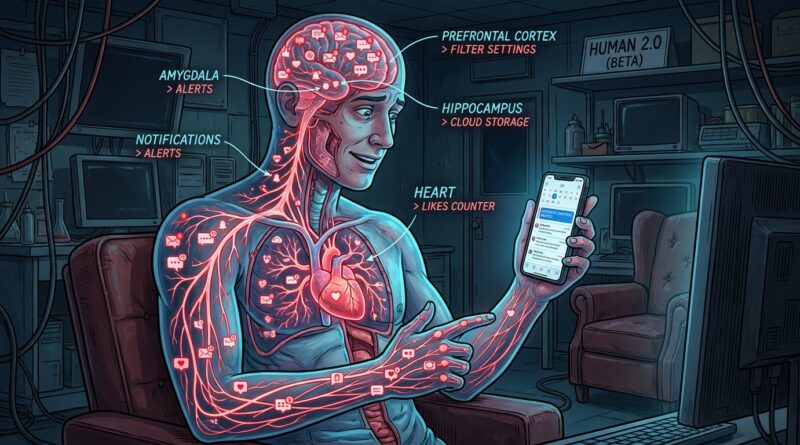
Homo Proxy‑Sapiens: When Humans Evolved To Outsource Their Feelings To Notification Settings
You are not broken if your heart now waits for a buzz before it files a feeling. That is the part nobody says out loud. A friend can disappoint you, a parent can worry you, a partner can miss you, and somehow none of it feels fully real until the phone lights up and gives the emotion official paperwork. No banner, no badge, no nervous system response. We used to notice loneliness in the body. Now we notice it when someone leaves us on read. Welcome to Homo Proxy-Sapiens, the proud new branch of human evolution that has outsourced emotional triage to notification settings. It would be funny if it were not so weirdly accurate. The phone is no longer just a tool. It is the receptionist for your inner life, deciding which people get put through, which feelings go to voicemail, and which existential crises are gently marked as “deliver quietly.”
⚡ In a Hurry? Key Takeaways
- This satire on human evolution and phone notifications points at a real problem. Many people now feel events more strongly when a device marks them as urgent.
- Try a quick reset. Turn off non-human alerts for one day and move your most important people to favorites so your attention reflects your values.
- This is not about shaming phone use. It is about noticing how notification systems can flatten relationships and training your brain to feel first, ping second.
The New Species Profile
If a biologist from the future dug up our habits, they would have a field day.
Here lies a creature with advanced language, rich emotional capacity, and the strange reflex of checking a rectangle before deciding whether to care. It startles at a shopping app. It ignores its own fatigue. It can miss three signs of burnout but respond instantly to a red bubble containing the number 1.
That is the joke. It is also the diagnosis.
What changed
Humans used to get emotional cues from tone of voice, facial expression, silence, absence, touch, tension in the room. Messy stuff. Analog stuff. Then we built a tiny machine that sorted all incoming signals into a cleaner system. Ping means maybe important. No ping means probably not. Over time, the body adapted to the shortcut.
Not fully, of course. You still have instincts. You still have gut feelings. But now they have competition from a louder middle manager.
Your Phone Is Not Just Interrupting You. It Is Ranking Reality
This is the part that sneaks up on people. Notification settings do not only control noise. They train salience.
If your ex texts and it appears on your lock screen, your body gets a full event. If your sibling quietly needs help but sends no dramatic wording, it may slide under the psychic radar. If five strangers like your post, your brain gets a mini parade. If your partner has been emotionally distant for a month, that can somehow feel less immediate because there is no push alert saying “urgent relational drift detected.”
The result is not that we stop feeling. It is that we begin feeling by proxy.
The lock screen as emotional customs office
Every incoming thing stands in line waiting to be declared significant. Some get waved through with lights and sounds. Others are held in digital detention until you happen to open the app. That means your nervous system is no longer reacting to life as it happens. It is reacting to life as filtered by software settings, app design, and whatever engagement trick worked best on you last month.
Why Relationships Start Feeling Hollow
People keep asking why connection feels thinner even while everyone is always in touch. This is one answer.
When your attention is trained to react most strongly to interruptions, steady love starts losing to dramatic contact. Quiet reliability cannot compete with a vibrating pocket. Real intimacy often arrives with no animation at all. It looks boring next to the engineered thrill of being noticed.
That is one reason modern communication can feel crowded and empty at the same time.
If this sounds familiar, you might also enjoy Homo Algorithmus: When Humans Evolved Into Emotional Support Pets For Their Own Feeds. It makes a similar point from a different angle. At some point the feed stopped being a tool and started training the owner.
The Biology Joke Works Because Your Brain Loves Shortcuts
Satire lands here because the behavior is absurd, but the mechanics are ordinary. Your brain is built to notice novelty, pattern breaks, social signals, and possible rewards. Notifications bundle all four together in one tidy little package.
That does not mean you are weak. It means you are extremely normal in a system built to grab normal human wiring and shake it until coins fall out.
Three traits of Homo Proxy-Sapiens
1. Conditional awareness. The person knows something matters only after the device confirms it.
2. Badge-based mood swings. A red number can create urgency out of nothing. A lack of alerts can create emotional free fall.
3. Outsourced reassurance. Instead of asking “How do I feel?” the person asks “Did anyone react?”
The Quiet Danger Is Not Noise. It Is Misclassification
Most advice about phones focuses on distraction. Fair enough. But distraction is the obvious problem. The weirder problem is misclassification.
Your phone is constantly telling your body what counts. The sale counts. The breaking news counts. The app trying to win back your attention definitely counts. Meanwhile grief, boredom, tenderness, regret, trust, and slow-building resentment often get no sensory fireworks at all.
So the system slowly teaches a bad lesson. If it does not interrupt me, it cannot be that important.
That is how people miss their own lives while staying perfectly updated.
How To Test Whether Notifications Are Driving Your Feelings
You do not need to move to a cabin or throw your phone in a river. A small experiment will tell you plenty.
Run the 24-hour salience audit
For one day, turn off every non-human notification you can live without. Shopping apps, news alerts, game nags, “someone posted” nonsense, all of it.
Then ask three questions every few hours.
What am I feeling right now, before I check my phone?
Who actually matters to me today?
What did I almost miss because nothing buzzed?
This is useful because it separates internal signals from manufactured urgency.
Promote people, demote platforms
Make a short list of humans who deserve direct access to your attention. Favorites, emergency bypass, whatever your phone calls it. Then remove alert privileges from services whose business model depends on acting like people.
That one change is oddly powerful. It tells your brain that relationships outrank marketing.
Feel first, check second
Before opening the phone in a tense moment, pause for ten seconds. Name the feeling without outside input. Annoyed. Lonely. Relieved. Jealous. Hopeful. Then check.
It sounds tiny. It is not. You are retraining the order of operations.
Satire Helps Because Shame Usually Does Not
A lot of people know their habits are off. What they do not have is language that makes the problem visible without making them feel stupid.
That is why the mock evolution frame works so well. It turns private embarrassment into a species-level observation. Instead of “I am pathetic because I care too much about notifications,” the frame becomes “Ah yes, classic Proxy-Sapiens behavior. Fascinating specimen. Mildly overclocked reward system. Startled by ghost vibrations.”
Now you can look at the behavior with curiosity. And curiosity is much more useful than doomscrolling your way into self-disgust.
At a Glance: Comparison
| Feature/Aspect | Details | Verdict |
|---|---|---|
| Emotional priority | Without intervention, phones often rank alerts by engagement value, not human value. | Convenient, but terrible at knowing what your heart actually needs. |
| Relationship quality | Constant pings can make contact feel frequent while real intimacy gets thinner and more reactive. | High volume is not the same as closeness. |
| Best fix | Cut low-value alerts, elevate key people, and pause before checking so your own feelings get first say. | Simple, realistic, and more effective than dramatic digital detox talk. |
Conclusion
Everybody is busy arguing about AI companions, synthetic lovers, and whether machines will fake intimacy well enough to fool us. Meanwhile the quieter shift is already here. We have trained our attention systems to act like proxies, reacting mostly to whatever pings first. That is a bigger story than it looks, because it changes how we rate urgency, connection, and even our own inner lives. A good satire on human evolution and phone notifications gives people a way to see this without panic. You are not a failed person. You are a very successful test subject in an environment built to hijack salience. The good news is that once you can name the species, you can study it. You can tweak the settings. You can put real people back above app theater. And you can start feeling things before your lock screen grants permission.