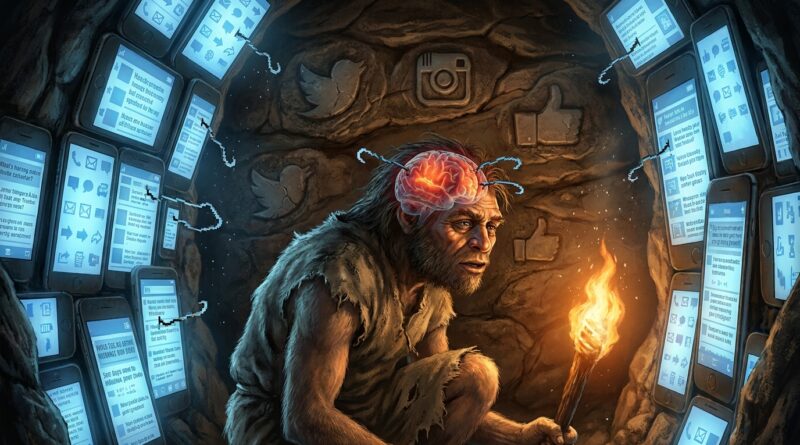
Rise of Homo Doomscrollus: What Happens When Paleolithic Brains Meet Infinite Feeds
It happens fast. You check one headline before bed, then another, then a video, then a comment thread full of panic and outrage. Suddenly it is 1:47am, your eyes hurt, your brain feels buzzy, and somehow you are still scrolling. If this keeps happening, it does not mean you are lazy or weak. It usually means your very old human wiring is getting pushed around by very new systems built to keep you looking, tapping, and coming back for more. Doomscrolling feels personal, but a lot of it is biology meeting software design. That matters, because guilt is a lousy fix. Understanding the trap works better. Once you see why your brain clings to bad news and endless feeds, you can stop treating this like a moral failure and start treating it like what it is. A predictable mismatch between Paleolithic instincts and infinite modern attention machines.
⚡ In a Hurry? Key Takeaways
- Doomscrolling is not just bad self-control. It is often a human evolution doomscrolling problem, where ancient threat-detection systems meet feeds designed to never end.
- The most effective fixes are environmental, not heroic. Move the phone, add friction, set stop points, and avoid “just one more scroll” in bed.
- If doomscrolling is feeding severe anxiety, sleep loss, or depression, it is worth talking to a doctor or therapist. This is a habit loop, but it can also pile onto real mental health strain.
Why bad news sticks to your brain
Your brain did not evolve for push alerts, autoplay, and infinite feeds. It evolved to notice threats quickly and remember them well. That used to be useful. The human who paid attention to rustling in the bushes was more likely to stay alive than the one who shrugged and went back to berry-picking.
That old survival system is still with us. The problem is that your brain treats social conflict, alarming headlines, and uncertain updates as things that might matter for your safety or status. It does not always know the difference between “possible tiger nearby” and “stranger on the internet says everything is collapsing.”
This is why doomscrolling feels weirdly compelling. Negative information grabs attention. Uncertainty keeps attention locked in. And the promise that the next swipe might finally bring clarity keeps your thumb moving.
Human evolution doomscrolling, in plain English
If you want the short version, here it is. Your brain likes novelty, watches for threats, and hates unfinished business. Social apps and news feeds are built around novelty, threats, and unfinished business.
That is the whole ugly magic trick.
1. We are tuned to notice danger
Psychologists sometimes call this negativity bias. Bad news often feels more urgent than good news. You can read ten calm updates and one alarming one, and guess which one keeps rattling around in your head at midnight.
2. We are reward hunters
Humans like variable rewards. Not every swipe gives you something interesting, but sometimes it does. That pattern is powerful. It is the same basic reason slot machines work so well. Unpredictable rewards can keep behavior going longer than reliable ones.
3. We hate not knowing
Anxious brains often look for closure. If the world feels unstable, scrolling can feel like research. It feels active. Responsible, even. But often it is not giving you useful information. It is just giving you more inputs and more stress.
4. We care what the tribe is doing
Humans are social creatures. In older times, being out of step with the group could carry real risks. Today, that ancient sensitivity can turn into compulsive checking. What are people saying? What did I miss? Is everyone else reacting to something important?
If this sounds familiar, you might also like Rise of Homo Distractus: How Smartphones Out-Evolved Our Brains. It nails that modern feeling of picking up your phone for one thing and resurfacing much later in a completely different corner of the internet.
Why infinite feeds beat “just use more willpower”
A lot of advice about screen habits is quietly insulting. It acts like the problem is that you lack discipline, as if millions of people all independently decided to become flaky, distracted zombies at the exact same point in tech history.
That is not what happened.
Apps are tested, measured, and refined to hold attention. Designers look at what keeps people engaged longer, what increases taps, what encourages return visits, what prevents stopping. The feed is often bottomless on purpose. The next post loads before you make a conscious choice. Friction is removed. Stopping cues disappear.
A newspaper ends. A magazine ends. Even a TV show has credits. Your feed does not. That matters more than people think.
What doomscrolling actually does to your mood and sleep
Most people already know doomscrolling feels bad. What is less obvious is why it can leave you both wired and drained.
It keeps your threat system switched on
If you spend an hour taking in outrage, conflict, disaster, and uncertainty, your body does not always settle neatly when you put the phone down. You may feel restless, tense, or mentally noisy.
It steals sleep twice
First, it simply eats time. Second, the content itself can make it harder to fall asleep. Add bright screens late at night and you have a solid recipe for wrecked rest.
It shreds attention
Rapid shifts between emotionally charged snippets train your brain to expect novelty fast. Then ordinary tasks, like reading a long email or focusing on a boring spreadsheet, can feel painfully slow.
How to regain control without pretending you will delete every app
This is the part people actually need. Not a purity test. Not “move to a cabin.” Just realistic ways to make the trap weaker.
Put distance between you and the feed
The easiest win is physical. Do not sleep with the phone in arm’s reach. Charge it across the room, or better yet, outside the bedroom. If that feels dramatic, start smaller. Put it in a drawer after a set time.
Distance works because it interrupts automatic behavior. If your hand cannot grab the phone half-asleep, you have a chance to choose instead of react.
Add friction on purpose
Friction is your friend. Log out of the apps you compulsively open. Remove them from the home screen. Turn off notifications that are not from actual humans you know. Use app limits if they help, but do not rely on them alone. The goal is to make mindless entry harder.
Never use the feed as your bedtime activity
If you know you are vulnerable at night, stop arguing with that fact. Bed is where good intentions go to die. Replace “I will just check for a minute” with something finite. A saved article. A crossword. An e-reader. Music. A podcast with a sleep timer. Anything with an end point.
Set a mission before you open your phone
Say it out loud if you need to. “I am checking tomorrow’s weather.” “I am replying to Sam.” “I am looking up train times.” Tiny missions cut down drift. Wandering is where the feed gets you.
Use stop cues that your brain can notice
Infinite feeds remove natural stopping points, so create your own. Set a 10-minute timer. Decide “three articles, then done.” Watch on a browser instead of the app. The point is not perfect obedience. It is giving your brain a clear off-ramp.
Do not confuse consuming with preparing
This one is huge. Ask yourself, “Is more of this helping me do anything useful?” Sometimes the answer is yes. Often it is no. You are not getting safer. You are just getting more saturated.
Replace the reward, not just the habit
Doomscrolling often gives quick novelty, emotional stimulation, and a weird sense of connection. If you remove it, your brain will want something in that slot. Have a substitute ready. Group chat with actual friends. A game with a hard end. Reading on paper. Stretching while listening to something light. Tea and a dumb sitcom. It does not need to be saintly. It just needs to be less engineered to trap you.
When guilt makes the problem worse
People often doomscroll, feel terrible, then add a layer of self-disgust on top. That extra shame tends to make self-control worse, not better. You feel bad, so you look for relief. The phone offers immediate relief. Then the cycle repeats.
A better frame is this: your brain is doing a very old thing in a very unnatural environment. Once you see that, you can start changing the environment instead of insulting the brain.
What “better” looks like in real life
You do not need to become a digital monk. You just need fewer automatic losses.
Maybe “better” means no phone in bed five nights a week. Maybe it means checking the news once in the morning and once in the evening, instead of every spare minute. Maybe it means deleting one app from your phone but keeping it on your laptop. Small changes count because doomscrolling thrives on convenience and repetition.
The win is not perfection. The win is that your attention starts belonging to you more often.
At a Glance: Comparison
| Feature/Aspect | Details | Verdict |
|---|---|---|
| Why doomscrolling feels irresistible | Ancient threat detection, novelty-seeking, and social curiosity are being triggered by endless feeds and unpredictable rewards. | Not a character flaw. It is a strong built-in bias being used against you. |
| Best practical fix | Add friction. Keep the phone away from bed, turn off nonessential alerts, remove apps from the home screen, and use timers or fixed check-in windows. | More realistic than relying on pure willpower. |
| What success actually means | Less automatic scrolling, better sleep, fewer panic spirals, and more intentional phone use. | Aim for improvement, not total app abstinence. |
Conclusion
If you keep getting pulled into doomscrolling, the useful question is not “Why am I so weak?” It is “What kind of brain do I have, and what kind of machine is it up against?” That shift matters. It replaces vague guilt with a clearer picture of what is happening. Human evolution doomscrolling is really a mismatch story. Stone-age reward and threat circuits, meeting systems optimized to keep those circuits engaged. Once you understand that, the fixes get more sensible. Use friction. Create stopping points. Keep the phone out of bed. Swap late-night scrolling for something finite. You do not have to delete every app or become a wellness robot. You just need a few smart barriers that give your better judgment a fighting chance. That is often enough to sleep better, feel less fried, and stop treating yourself like the problem.