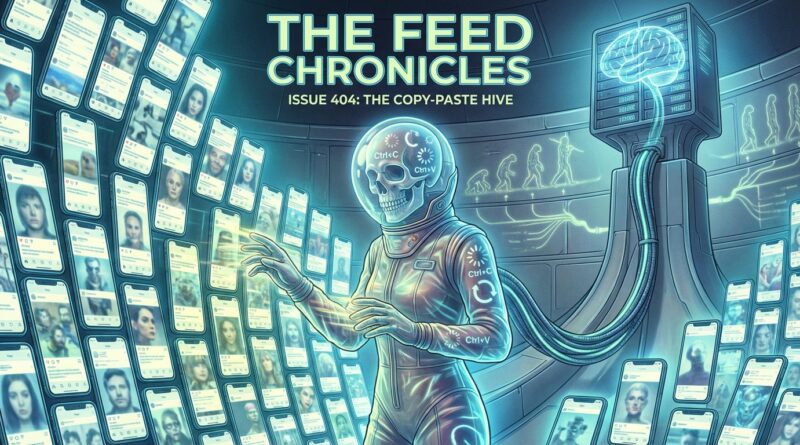
Homo Copy-Pasta: How We Outsourced Original Thought To The Algorithmic Hive Mind
You are not imagining it. The internet really does feel like one giant group project where everyone copied from the same kid and changed three words before handing it in. You scroll past hot takes that sound machine-smoothed, jokes that arrive pre-aged, and heartfelt posts that somehow all use the same rhythm, the same pause, the same little moral at the end. It is tiring. Worse, it makes you wonder whether culture is still being made or just endlessly reformatted.
If that uneasy feeling has been bugging you, there is a reason. We spent years talking about the web as a place where people think together. What it often became instead is a place where people copy together, faster and at scale. Recommendation systems reward familiarity. Memes flatten nuance into templates. Generative tools offer instant polish with the side effect of making everything sound like it came from the same very eager intern. The result is not just boring content. It is a quieter kind of loss. Our thoughts start arriving pre-shaped.
⚡ In a Hurry? Key Takeaways
- Humans are not just using the algorithm. We are starting to imitate its favorite patterns, and that makes culture feel oddly samey.
- A quick fix is to add friction before you post. Pause, rewrite in your own voice, and ask, “Would I say this out loud to a friend?”
- This is less about robots replacing humanity and more about convenience quietly sanding off originality. The good news is you can push back today.
Welcome to Homo Copy-Pasta
Picture a nature documentary voice.
Here we see the modern human in its native habitat, lit by the pale glow of a phone screen. Notice the swift thumb movement. Observe the ritual exchange of recycled opinion fragments. A fascinating species. Social. Adaptive. Mildly caffeinated.
If early humans evolved to track berries, predators, and social cues, modern humans seem to be evolving to detect what is already performing well on the feed. We no longer merely share ideas. We share formats. We share tones. We share the approved emotional settings for discussing everything from politics to sandwich shops.
This is why a satirical essay on human evolution into an algorithmic hive mind does not feel all that satirical. The joke lands because we have all seen it happen. Maybe in others first. Then, uncomfortably, in ourselves.
How We Got Here Without Noticing
Step 1. Memes taught us to think in templates
Memes are funny because they compress a whole idea into a shape your brain recognizes instantly. That is their magic. It is also their trap. Once enough of your daily communication happens through templates, you start reaching for prefabricated feeling. Instead of “What do I think?” the question becomes “Which format fits this?”
That is great for speed. Not so great for original thought.
Step 2. Recommendation engines rewarded the familiar
Algorithms are not evil masterminds sitting in volcano lairs. They are closer to overexcited shop assistants who keep handing you more of whatever you paused near for two seconds. If outrage worked yesterday, here is more outrage. If soft, polished life advice worked this morning, here are 900 near-identical versions by lunch.
Over time, creators adapt. Of course they do. Humans are clever apes with rent. If a certain phrasing, structure, or tone gets rewarded, people use it. Then everyone uses it. Then the style becomes invisible because it is everywhere.
Step 3. Generative tools polished the copy loop
Now add AI writing, image generation, and auto-complete systems. These tools are useful. They save time. They can help people get unstuck. But they are trained on patterns, and patterns are past behavior with a nice haircut.
So when a lot of people use the same systems to speed up expression, they often get a cleaner, shinier version of average. Not always. But often enough that you can feel it in your bones after ten minutes online. Everything is readable. Everything is competent. Everything feels faintly dead behind the eyes.
The Quiet Crisis Is Not Just Bad Content
The loud version of the AI conversation is about disaster movies. Killer robots. Job loss. Humanity getting checkmated by a toaster with venture capital. Those are real debates.
But the quieter crisis is stranger and more intimate. Humans are becoming distribution nodes instead of origin points. We pass along styles, opinions, and emotional scripts that arrive pre-approved by the machine logic of engagement.
That changes your inner life.
You begin to mistake resonance for truth because a thousand people already phrased it nicely. You begin to mistake polish for wisdom because the sentence sounds finished. You begin to mistake participation for thought because you posted the right shape at the right time.
And yes, that sounds dramatic. But so does realizing half your opinions now have the same cadence as a motivational LinkedIn post.
Symptoms of the Algorithmic Hive Mind
You may be experiencing mild to moderate Hive Mind if any of the following sound familiar:
- You can predict the next five comments under a post before opening them.
- You read a “deeply personal” post that somehow sounds exactly like 400 others.
- You start typing a thought and realize you are borrowing not just the idea, but the whole delivery system.
- You have seen the same joke in six fonts and laughed at four of them.
- You feel oddly lonely while consuming endless “relatable” content.
That last one matters. Standardization often creates the illusion of connection while quietly draining the weird little specifics that make real connection possible.
Why Our Brains Fall for This So Easily
Because our brains are not broken. They are ancient.
Humans are built to copy successful behavior. It is one of our best tricks. You do not reinvent fire, shelter, or language every morning. You inherit useful patterns from the group. That is efficient. It kept people alive.
The problem is scale.
In a village, copying helped you learn from a few dozen or a few hundred people. Online, you are exposed to optimized patterns from millions of people and machines that never sleep. The social learning system in your head was built for campfires. It now lives inside a casino designed by statisticians.
No wonder it gets weird.
The New Status Game: Be Original, But Only in Approved Ways
Here is one of the nastier jokes of internet life. We say we value authenticity, but platforms often reward recognizable authenticity. The kind with good lighting. The kind with a tested opening hook. The kind that feels vulnerable while remaining algorithm-safe.
So people perform individuality through increasingly standardized signals. It is the digital version of buying a factory-distressed jacket to show you are rugged and free.
Again, no shame. We all do some version of this. Humans are social creatures. We tune ourselves to the room. It is just that the room is now global, monetized, and weirdly obsessed with engagement graphs.
How to Resist Becoming Another Copy in the Stack
1. Add one beat of friction
Before posting, pausing, or forwarding, stop for ten seconds. Ask one small question. “Do I actually think this, or do I just recognize it?” That single beat of friction can break the autopilot loop.
Friction sounds boring. It is also how originality sneaks back in.
2. Rewrite the thought in speaking voice
If a sentence sounds impressive but not like something you would ever say out loud, that is a clue. Rewrite it as if you are texting a smart friend. Keep the idea. Lose the synthetic glaze.
This works especially well when AI tools help you draft something. Use the draft. Then make it human. Put your own fingerprints back on it.
3. Consume fewer summaries, more source material
If all you eat is commentary on commentary, your mind starts to sound like a highlights reel. Read the article, not just the post about the article. Watch the interview, not just the clipped reaction to the interview. Let your brain touch raw material again.
4. Keep one private space for unperformed thought
A notebook helps. So does a notes app nobody else sees. Write badly there. Write half-formed thoughts. Write things with no audience in mind. Originality often starts as a mess. If every thought has to be post-ready, it will come out prefab.
5. Follow people who are specific, not just polished
Specificity is hard to fake. Real experience has texture. It includes odd details, rough edges, and sentences that do not sound focus-grouped. The more you feed your mind that kind of material, the easier it becomes to notice when something is merely smooth.
A Better Use for AI, If You Are Going to Use It
Use AI as a bicycle, not a chauffeur.
Let it help you organize notes, suggest angles, clean up grammar, or poke holes in your argument. Fine. Useful. But if it starts doing your perceiving for you, that is the danger zone. Machines are very good at recombining what has already been said. Your job is to notice what has not been noticed yet, or at least to say it in a way that is honestly yours.
That difference matters. It is the difference between assistance and ventriloquism.
The Small Rebellion That Still Works
You do not need to go live in a cabin and handwrite manifestos with a fountain pen. You just need to become slightly less frictionless.
Make one post less optimized. Leave one thought unshared until it ripens. Read one thing slowly. Say one thing in a clumsy but honest way instead of a polished borrowed voice. Refuse the tiny pressure to package every feeling for instant circulation.
This is not grand resistance. It is more like digital posture correction. Small adjustments that keep your mind from slumping into the default shape of the feed.
At a Glance: Comparison
| Feature/Aspect | Details | Verdict |
|---|---|---|
| Copying together | Fast, socially rewarding, easy to share, but often produces samey opinions and polished repetition. | Convenient, but mentally flattening over time. |
| Thinking together | Slower, messier, includes disagreement and rough edges, but creates fresher ideas and real perspective. | Harder work, better culture. |
| Using AI as a helper | Useful for editing, brainstorming, and structure, as long as your own judgment and voice stay in charge. | Best option if you keep your hands on the wheel. |
Conclusion
The real worry is not just whether AI will take jobs or build scary machines. It is whether the rest of us will quietly hand over the stranger, funnier, less efficient parts of being human because smooth repetition is easier. That is the discomfort many people already feel when they scroll past the same recycled takes and AI-polished posts. The good news is that you can name it, laugh at it, and push back. Keep one part of your mind offline from the crowd. Add a pause before you repeat. Write one sentence that sounds like you and nobody else. Culture does not stay alive because it is optimized. It stays alive because people keep making weird, specific, honest things before the hive mind can sand them down.