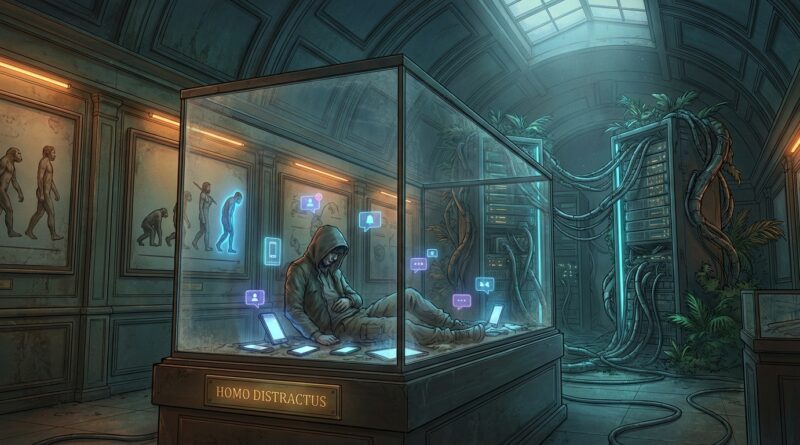
Rise of Homo Distractus: How Smartphones Out-Evolved Our Brains
You pick up your phone to check one message. Twenty minutes later, you are watching a stranger organize their fridge, half-reading a news alert, and wondering why you walked into the kitchen. If that sounds familiar, you are not broken. You are living in a system that treats your attention like an open-pit mine. Every ping, badge, autoplay clip, and infinite feed is built to keep you nibbling at scraps instead of finishing a thought. That is why so many of us feel less like sleek digital citizens and more like twitchy little lab animals pressing a shiny button for one more pellet. The joke is funny because it hurts. A satirical take on human evolution in the attention economy lands right now because it gives the problem a face. Homo Distractus is not a moral failure. It is what happens when very smart companies spend years training your brain to expect interruption as the default setting.
⚡ In a Hurry? Key Takeaways
- Homo Distractus is a funny name for a real problem. Smartphones and feeds are training us into constant partial attention.
- You can push back by cutting notifications, adding friction to addictive apps, and making focused time easier than distracted time.
- This is not about becoming a monk. It is about protecting your brain from tools designed to interrupt you for profit.
Meet Homo Distractus
Picture the species profile.
Head tilted down. Thumb highly developed. Startles at phantom vibrations. Can no longer watch one show without also browsing two apps and mentally drafting a grocery list. Feeds mostly at dawn, lunch, and 1:14 a.m.
That is the joke version. The less funny version is that our devices did not just show up to help us check maps and text our family. They slowly became slot machines in our pockets. Not evil in a cartoon villain way. Just extremely good at learning what keeps us tapping.
The old story of human evolution was about adapting to the environment. The new one feels like the environment adapting to our weak spots first. Bored for three seconds? Here is a clip. Slightly lonely? Here is a notification. Mildly curious? Here are 400 tabs and a comment section that ruins your afternoon.
Why Your Brain Feels Smaller Than It Used To
Your brain is not actually shrinking. It just keeps getting interrupted before it can warm up.
Attention likes runway
Most worthwhile thinking needs a few quiet minutes before it starts doing anything useful. Reading, writing, planning, even enjoying music all need runway. Notifications chop that runway into tiny strips. You never quite take off.
Feeds reward reaction, not reflection
The modern phone experience is built around quick responses. Tap. Swipe. Like. Dismiss. Repeat. This keeps you active, but not always engaged. It can leave you with the weird feeling of doing a lot and absorbing almost nothing.
Your phone is never just one thing
A book is mostly a book. A notebook is mostly a notebook. A phone is your camera, TV, office, casino, gossip line, family portal, shopping mall, and panic machine. It is very hard to use one feature calmly when twelve others are standing behind it waving.
The Attention Economy Is Not Being Subtle
We should be honest about the business model here. Many apps are free because your attention is the product being sold. The longer you stay, the more ads you see, the more data you produce, and the better the machine gets at predicting what will keep you there.
That is why so much software feels oddly needy. Red dots. Streaks. Suggested videos. “People are waiting.” “You missed this.” “Come back.” It is less like owning a tool and more like living with a very clingy roommate who keeps jangling keys in your face.
And now the internet is packed with low-effort content, recycled posts, and AI-made sludge that exists mainly to grab a glance. People joke that the web feels dead because so much of it no longer feels made for human curiosity. It feels made for throughput.
A Field Guide to the Species
If you want the satirical version, here are a few common traits of Homo Distractus.
Distinctive call
“Sorry, what were you saying?”
Nesting habits
Keeps charger by bed. Claims phone is an alarm clock. Somehow ends each night under the blue glow of thirty-seven open tabs.
Defensive behavior
Insists they can multitask. Cannot, in fact, multitask. Is simply switching tasks fast enough to feel busy.
Mating display
Sends “haha” to a meme while physically sitting next to the recipient.
Predators
Auto-play, doomscrolling, outrage bait, algorithmic recommendations, phantom urgency, and the phrase “you may also like.”
The reason this satire works is simple. It names a pattern we all recognize. Once something has a name, it feels less like a personal failing and more like a design problem you can do something about.
How Smartphones Out-Evolved Our Brains
Human evolution is slow. App evolution is Tuesday.
Your nervous system still runs on ancient hardware. It is drawn to novelty, social signals, possible threats, and rewards. Phones are very good at packaging all four. Every refresh is a maybe. Every message is a social cue. Every headline is either a crisis or a promise. Your brain says, “This could matter.” The app says, “Exactly.”
That does not make you weak. It makes you normal. If anything, the surprising part is that any of us get anything done at all.
The sharpest apps are constantly tested, tuned, and updated to hold your focus a little longer. Your poor prehistoric wiring is going up against teams of designers, behavioral researchers, and product managers whose bonuses may depend on engagement graphs moving up and to the right.
Signs You May Be Fully Evolved Into Homo Distractus
You do not need all of these. Two or three will do.
- You unlock your phone without knowing why.
- You check messages in the middle of movies, meals, and conversations you actually care about.
- You feel itchy when nothing is happening.
- You read the same paragraph three times because your brain keeps reaching for escape hatches.
- You confuse stimulation with rest.
- You think “I need a break,” then spend that break consuming content that leaves you more tired.
The Good News: Devolution Is Optional
You do not need to throw your phone in a lake. You just need to stop letting it be the loudest object in your life.
1. Turn off almost all notifications
Not “manage them better.” Turn them off. Keep calls from important people, calendar alerts you truly need, and maybe messages from a short VIP list. Everything else can wait until you choose to look.
This one change is boring, which is exactly why it works.
2. Make distracting apps harder to reach
Move them off the home screen. Put them in a folder with a mildly judgmental name like “Time Sink” or “Not Now.” Log out if you are brave. Add friction. Tiny annoyances help break automatic habits.
3. Make focused tasks easier to start
Open the notes app before you need it. Keep a book by the couch. Put your workout app where social media used to be. Good habits are more likely when the path is short and obvious.
4. Use grayscale if you need a reset
Colorful icons are candy for the brain. Grayscale makes your phone look less like a toy aisle and more like a tax form. It is not magical, but it can take the shine off compulsive checking.
5. Create phone-free zones
The dinner table is a good start. The bedroom is even better. If your phone sleeps next to you, it is not just an alarm clock. It is a 24-hour casino whispering your name.
6. Replace scroll-rest with actual rest
When you are tired, try something that truly lowers the mental noise. A walk. Music. Stretching. Tea and a chair. Looking out a window like a Victorian person with unresolved feelings. The point is to stop confusing input with recovery.
7. Notice the trigger before the tap
Most compulsive checking starts with a feeling. Boredom. Anxiety. Delay. Social discomfort. If you can spot the feeling, you get a tiny gap in which to choose something else.
This Is Not About Being Pure
Some people hear advice like this and assume the goal is digital sainthood. It is not. You are allowed to enjoy your phone. You are allowed to watch nonsense, send memes, and waste a little time. Humans need play.
The problem starts when every spare second is pre-colonized by something noisy and optimized. Then your mind never gets to wander, settle, or form a full thought without being pickpocketed.
The answer is not guilt. It is boundaries. Good fences make better brains.
What Pushing Back Actually Looks Like
It looks ordinary.
Reading six pages without checking your phone. Taking a walk without headphones. Leaving one message unanswered for an hour. Watching one episode of something without also grazing through three apps. Letting boredom sit in the room long enough to turn into an idea.
That may not sound dramatic, but in the attention economy, calm is a small act of rebellion.
At a Glance: Comparison
| Feature/Aspect | Details | Verdict |
|---|---|---|
| Notifications | Designed to pull you back with urgency, color, and social pressure. | Cut aggressively. Most are not worth the brain tax. |
| Infinite feeds | Great at filling micro-moments, bad at leaving you refreshed or focused. | Use with limits, not as a default background activity. |
| Phone-free routines | Simple habits like no-phone meals, walks, or bedtime create breathing room for attention. | Best long-term fix because it changes the environment, not just your willpower. |
Conclusion
If the internet feels dead, weird, and clogged with AI slop, you are not imagining it. If your own brain feels a little frayed from all the noise, that is not a personal defect either. Attention is a scarce resource now, and plenty of systems are competing to grab it before you can use it for your own life. That is why a satirical field guide to Homo Distractus matters. It gives you language for the mess, a laugh when you need one, and a practical reminder that you can still push back. Not by becoming perfect, but by being slightly harder to farm. In a world of weaponized feeds and endless synthetic junk, protecting a few square feet of your own mind is not silly. It is survival.