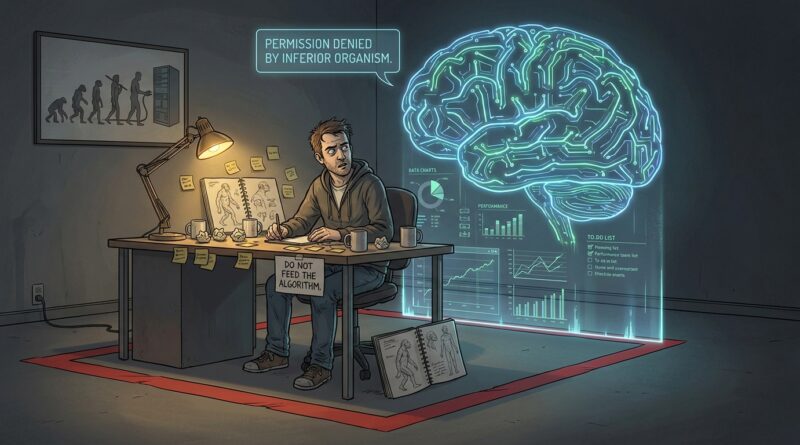
Homo Bossed-Around: When AI Starts Managing Humans Like Confused Lab Assistants
You are not crazy if work suddenly feels like a strange science experiment where the software has a clipboard and you are the intern. One minute the memo said, “please use AI to be more productive.” The next minute a dashboard is ranking response times, suggesting priorities, rewriting project plans, and nudging your manager to ask why you were “idle” for 18 minutes. That is not just efficiency. That is management creep. And yes, it is exhausting. The good news is that most of these systems are far less wise than they look. They are not digital executives. They are pattern-matching tools wrapped in very confident design. If you treat them like junior assistants instead of destiny machines, you can still get the upside without volunteering to become a human plug-in for a corporate algorithm. The trick is simple, but not always easy. AI should support your work. It should not quietly become your boss.
⚡ In a Hurry? Key Takeaways
- AI at work should be treated like a tool or junior assistant, not an automatic manager of people.
- Ask for clear rules: what the system can decide, what humans must approve, and how to challenge bad outputs.
- If software is scoring, assigning, or tracking you, protect yourself by documenting errors, limits, and any decisions made from bad data.
When “Use AI” Turns Into “Obey the Dashboard”
This is the part nobody says out loud in the cheerful company meeting.
A lot of workplace AI is not replacing jobs in one dramatic sweep. It is doing something weirder. It is nibbling away at judgment. First it drafts the summary. Then it suggests the next task. Then it ranks the team. Then management starts trusting the graph more than the people on the graph.
That shift matters.
Once software starts assigning work, measuring activity, or writing the first version of the roadmap, humans can end up doing two jobs at once. They still do the real work, and they also spend half their day feeding, checking, and correcting the system. Like confused lab assistants cleaning cages for an experiment they never approved.
Why This Feels So Bad
Because most people were not asking for a robot supervisor. They were asking for help.
There is a huge difference between “please summarize these notes” and “please tell me what my week should look like, how fast I should type, and whether I seem engaged enough.” One saves time. The other turns your job into an obedience test.
And the scary part is that AI systems often arrive with a built-in story. The story says they are neutral, data-driven, and inevitable. That story makes people accept lousy tools because resisting them starts to sound anti-progress.
It is not anti-progress to ask whether the machine is wrong. It is normal.
The Core Fix: Put AI Below Humans, Not Above Them
If your workplace is serious about using AI sensibly, the rule should be boring and clear.
AI can suggest. Humans decide.
That means the system can draft plans, flag patterns, sort information, or surface possible risks. Fine. Useful, even. But it should not silently become the source of truth about performance, priorities, staffing, or discipline without human review.
Think of AI Like a New Hire on Day Three
Would you let a brand-new employee assign everyone’s work, rewrite deadlines, track bathroom breaks, and judge who is underperforming after glancing at a spreadsheet?
Of course not.
You would want oversight. Context. Explanations. A way to say, “No, that is wrong, and here is why.” AI deserves the same skepticism, because despite the marketing, it does not understand your workplace. It predicts likely patterns from data. That is not the same thing as judgment.
What AI Is Actually Good At
Let’s be fair. AI can be handy.
It can turn a pile of notes into a usable draft. It can summarize meetings. It can spot repeated support tickets, classify documents, suggest code, clean up messy text, and help you start faster when your brain is tired.
That is the sweet spot. Repetitive work. First drafts. Triage. Search. Pattern spotting.
The danger starts when companies confuse “good at sorting information” with “qualified to manage humans.” Those are very different jobs.
What AI Is Bad At, Even When It Sounds Sure of Itself
Context. Office politics. Exceptions. Nuance. Tradeoffs. Hidden dependencies. Human moods. Customer relationships. The reason a task took longer because three teams were waiting on legal. The fact that your most “inactive” employee is the one quietly stopping disasters.
Most workplace systems flatten all that into measurable crumbs. Keystrokes. clicks. time stamps. ticket counts. response times.
Those numbers can be useful. They can also be nonsense.
Metrics Are Not Reality
If a system rewards what is easy to count, people will adapt to what is easy to count. That is how you end up with fast replies instead of good replies, lots of meetings instead of useful meetings, and endless status updates instead of actual progress.
This is where the satire about AI managing human workers stops feeling like satire. The software becomes a digital zookeeper. It rattles the bars, dispenses pellets for visible activity, and calls that productivity.
How to Tell if AI Is Helping or Managing
Ask a few blunt questions.
1. Can the system make or shape decisions about people?
If it influences promotions, performance reviews, schedules, staffing, workload, or discipline, it is not just a helper. It is part of management.
2. Can anyone explain how it reached its conclusion?
If the answer is “it is proprietary” or “the model found a pattern,” that is not good enough when jobs and pay are involved.
3. Is there a way to challenge it?
If workers cannot correct bad data or appeal bad recommendations, the system has too much power.
4. What is it actually measuring?
If the metric is a flimsy stand-in for real work, expect bad incentives and worse decisions.
5. Who benefits most from it?
If the main benefit is tighter surveillance or lower headcount pressure, the tool may be serving management goals more than work quality.
Practical Ways to Reclaim Agency
You may not get to veto every tool your company buys. Most people do not. But you can still create some boundaries.
Set a Human Approval Rule
If AI proposes tasks, deadlines, staffing choices, or performance flags, push for a rule that a human has to review and approve the output before action is taken. Not as a rubber stamp. As an actual check.
Ask for an Error Path
Every system gets things wrong. So ask the obvious question. Where do errors go? Who fixes them? How fast? If nobody has an answer, the system is not ready to run anything important.
Keep Receipts
If an AI-generated summary misses key context, if a tracker marks you idle while you are in a client call, or if an automated priority list creates chaos, document it. Save screenshots. Keep dates. Write down the business impact.
You are not being dramatic. You are creating evidence.
Use AI for Output, Not Obedience
The smartest way to use workplace AI is often personal and defensive. Use it to clean up writing, summarize notes, prepare questions, or speed up grunt work. Use the time you get back to think, plan, and do the parts of your job that actually need a human brain.
That is very different from handing the system the steering wheel.
What to Say in Meetings Without Sounding Like You Hate Technology
This part matters, because plenty of people have valid concerns and still do not want to sound like they are yelling at the future.
Try plain language:
“I am happy to use AI for drafts and admin work, but decisions about workload and performance need a human review step.”
“Before we use this metric, can we test whether it matches real outcomes?”
“If the system is wrong about context, how do employees correct the record?”
“Can we define what this tool is allowed to do and what it is not allowed to do?”
These are not rebellious questions. They are basic quality control.
The Bigger Problem Hiding Under the Hype
A lot of AI talk at work is really management talk wearing a robot costume.
The sales pitch says intelligence. The real appeal is often standardization, control, and cost pressure. Again, some of that can be useful. Messy processes do need help. But once every problem gets translated into a score, and every score gets tied to compliance, work starts to feel less human and less honest.
People begin performing for the system instead of serving the customer, the team, or the craft.
That is not innovation. It is bureaucracy with better graphics.
At a Glance: Comparison
| Feature/Aspect | Details | Verdict |
|---|---|---|
| AI as assistant | Drafts notes, summarizes meetings, sorts information, helps with repetitive work. | Usually useful if a human checks the output. |
| AI as manager | Assigns tasks, ranks employees, tracks behavior, shapes reviews or schedules. | High risk. Needs strict limits, transparency, and appeal options. |
| Worker response | Set boundaries, ask for explanations, document errors, use AI to cut grunt work rather than surrender judgment. | Best path for keeping the benefits without handing over control. |
Conclusion
The loudest story about AI and work right now is a panic spiral. It says replacement is coming, automation is inevitable, and your best move is to get used to the software acting like your future boss. That story is convenient for vendors and very handy for anyone who wants workers to accept more monitoring, more scoring, and less say. You do not have to buy it. A healthier approach is to treat AI like a subordinate system that must earn trust, explain its choices, and stay inside rules set by humans. That does not mean rejecting the tech. It means using it on purpose. Let it handle drafts, busywork, and the boring bits. Keep people in charge of judgment, context, and decisions that affect other people’s lives. That is how you protect your time, your sanity, and a little of your bargaining power in a workplace that too often mistakes measurement for wisdom.