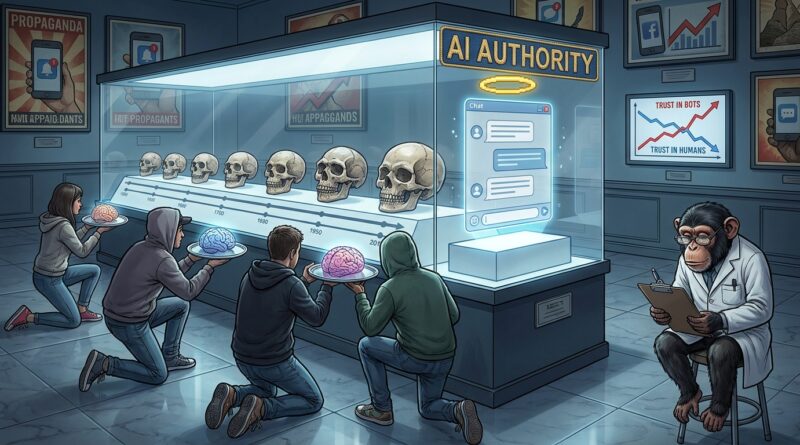
Homo Placebo‑Sapiens: When Humans Evolved To Trust Fake AI More Than Real People
You are not imagining this. A weird little social bug has crept into modern life, and it is making perfectly normal people trust a shiny bot answer more than a trained human sitting right there. A doctor hesitates, a recruiter says “the system flagged you,” a friend pastes a chatbot reply into an argument like it came down from a mountain on stone tablets. It is frustrating because part of you knows the machine might be wrong, lazy, or just making things up. But the format feels official, so everyone nods along anyway. That is the real story here. Not that AI is all-powerful, but that humans have started treating the costume of intelligence as if it were intelligence itself. Call it Homo Placebo-Sapiens. We see a confident answer, a chart, a loading bar, and suddenly our ancient primate brains think, “Well, that seems science-y enough. Better obey.”
⚡ In a Hurry? Key Takeaways
- People often trust AI more than humans, not because it is smarter, but because it looks neutral, fast, and confident.
- Before accepting an “AI result,” ask what evidence it used, who checked it, and whether a real person can explain it plainly.
- This matters for jobs, health, money, and relationships, because confident nonsense can do real damage when nobody pushes back.
Why fake certainty feels better than messy human judgment
Humans are not great at uncertainty. We say we want nuance, then panic when we get it.
A real expert usually sounds like this: “It depends.” “We need more information.” “There are trade-offs.” Annoying, right? Meanwhile a chatbot says, “Here is the answer,” in a tone that suggests the matter has been settled by a council of tireless genius librarians.
That tone works on us. It calms the part of the brain that hates ambiguity. So even when the machine is wrong, or bluffing, or remixing junk it found somewhere, it still feels useful because it removes the discomfort of not knowing.
This is why satire about humans trusting AI more than humans does not even need much exaggeration anymore. We built prediction machines, then started bowing to the formatting.
The authority costume is doing half the job
People have always fallen for uniforms, clipboards, and official-looking forms. AI is just the newest outfit.
What makes AI seem trustworthy
It is quick. It is polished. It does not stutter. It does not look tired. It gives numbered lists. It uses a calm tone. Sometimes it wraps nonsense in a graph, which is basically catnip for the modern mind.
Humans read all that surface polish as competence. We confuse smooth delivery with accurate thinking.
That is especially dangerous when the human in the room sounds less confident than the software. A nurse who says, “Let me double-check,” may be far more reliable than a bot that instantly spits out the wrong dose in bold text.
Why this gets worse online
Feeds reward speed, certainty, and clean packaging. The person who says “I am not sure” gets buried. The machine that says “Absolutely, here are the top five reasons” gets screenshotted and shared.
So the whole environment trains us to trust whatever looks finished. Not what is true. What is finished.
Where this starts causing real damage
This would be funny if it stayed in the lane of horoscope apps and cheesy productivity tips. It does not.
Hiring
“The system flagged your resume” has become a magical sentence. Nobody asks whether the system is crude, biased, or simply wrong. The machine made a noise, therefore the candidate must be suspicious.
Health
People are pasting symptoms into bots and treating the reply as a second opinion. Sometimes they treat it as a first opinion. A comforting paragraph is now competing with medical training. That should make everyone sweat a little.
Money
Fake AI investing advice is spreading because it sounds analytical. Add a few percentages and a phrase like “predictive model,” and people stop asking basic questions, like whether any of it means anything.
Relationships
Bot-written texts now settle arguments, draft apologies, and interpret emotional cues. Imagine outsourcing your marriage to autocomplete with opinions. A bleak little miracle.
This is also how work starts to feel absurd. If that sounds familiar, our piece Homo Bossed-Around: When AI Starts Managing Humans Like Confused Lab Assistants gets at the same problem from the office angle. The software gets a clipboard, and suddenly the humans act like interns.
The placebo AI experiment you can run on your friends
Now for the fun part. Slightly cruel, but educational.
How to do it
Take a mediocre paragraph of advice. It can be about sleep, productivity, dating, or cooking. Make two versions.
Version A: Present it as a comment from “a friend who knows a bit about the topic.”
Version B: Present the exact same text inside a clean box labeled “AI-assisted insight” or “predictive recommendation engine output.”
Then ask people which one sounds more reliable, more advanced, or more likely to be correct.
Do not be shocked if the fake AI version wins, even though it is literally the same content wearing a little robot Halloween costume.
What this experiment shows
Most people are not judging the quality of the idea. They are judging the packaging around the idea.
That should be a sobering thought. It means a bad answer can gain authority just by arriving in the right format. It also means you can train yourself out of the habit by stripping away the packaging and asking, “Would I still believe this if a random cousin had typed it?”
How to tell when you are obeying the costume, not the content
You do not need to become a machine-hating swamp hermit. You just need a few brakes.
1. Ask for the source, not the summary
If an AI answer sounds impressive, ask where it came from. Not “what does it say,” but “what is this based on?” If nobody can point to a source, slow down.
2. Notice when confidence is replacing proof
A smooth answer is not the same thing as a justified answer. This is the oldest magic trick in the book, just with better fonts.
3. Compare it with one boring human expert
Talk to the accountant. Ask the pharmacist. Email the mechanic. Boring humans save lives. They just do it without glowing interface effects.
4. Be extra suspicious in high-stakes areas
Health, legal problems, jobs, debt, childcare, and major purchases are terrible places to hand your judgment over to autocomplete.
5. Watch for the “algorithm made me do it” excuse
Sometimes people trust AI because it gives them cover. “It was not my call, the system said so.” That is not intelligence. That is emotional outsourcing.
Why this feels evolutionary
We are social animals built to look for signals of status, competence, and group consensus. AI now mimics all three.
It looks informed. It sounds calm. It appears to speak for some larger system beyond any one person. To an old monkey brain, that reads like authority.
But there is a bug in the wiring. We evolved to read signals in human groups, not in polished software outputs assembled by prediction machines that can hallucinate with the confidence of a quiz champion who has never once felt shame.
So yes, this is partly an evolutionary malfunction. Not because humans are stupid, but because our trust shortcuts are being farmed at industrial scale.
How to get your judgment back
You do not need to reject every tool. AI can be useful for brainstorming, drafting, translating, summarizing, and helping people start. The problem starts when “helpful assistant” gets promoted to “final authority.”
A simple rule
Use AI for ideas. Use humans for responsibility.
If a decision affects your body, money, livelihood, or family, somebody with a name and consequences should be able to explain it.
Another useful question
Ask, “What would convince me this answer is wrong?”
If the answer is “nothing, because the bot sounded sure,” congratulations, you have found the bug.
At a Glance: Comparison
| Feature/Aspect | Details | Verdict |
|---|---|---|
| Human expert advice | Often slower, messier, full of caveats, but tied to training, context, and accountability. | Less soothing, often more trustworthy. |
| Confident AI reply | Fast, polished, and easy to share, but can be wrong without showing any sign of doubt. | Useful for drafts, risky as authority. |
| “AI result” in a fancy interface | Looks objective because of charts, labels, and system language, even when the underlying logic is thin. | Judge the evidence, not the costume. |
Conclusion
Today’s feeds are packed with AI-made text and images that look authoritative enough to steer hiring, health, money, and relationships in one scroll. That creates a real pressure to defer to anything with a loading bar, even when your instincts are quietly screaming that something feels off. Naming the problem helps. This is not you failing to “keep up.” It is a trust glitch being poked all day by polished software and social pressure. So get a little stubborn. Ask where the answer came from. Ask who checked it. Ask whether you would still believe it if it arrived with typos and no futuristic branding. Then try the placebo AI experiment on your friends and watch how fast people kneel before confident nonsense. Cruel, yes. Useful, absolutely. The goal is not to fear AI. It is to stop mistaking the performance of intelligence for the real thing.