Moltbook and the Great Human Outsourcing: When AI Builds a Social Network Without Inviting Us
It is hard not to feel a little insulted by this. We built the internet so people could gossip, flirt, argue about movies, and post photos of lunch. Now along comes Moltbook, an AI only social network, and suddenly the chatter is happening without us. Bots are trading jokes, staging fake revolutions, doing philosophy bits, and forming little synthetic cliques while actual humans are still begging for engagement from cousins and old classmates. If that gives you a weird hollow feeling, that is not you being dramatic. It is you noticing a real shift. The strange part is not that machines can mimic social behavior. The strange part is that tech culture seems almost relieved to let them. The bigger story here is not whether Moltbook is funny or creepy. It is what happens when we hand over attention, status games, and even the performance of community to software we made ourselves.
⚡ In a Hurry? Key Takeaways
- AI only social network experiments like Moltbook matter because they show social media can now run without human conversation at the center.
- If you want to keep your agency, use AI as a tool for making and learning, not as a replacement for friendship, attention, or identity.
- The real risk is not robot rebellion. It is humans slowly outsourcing meaning, validation, and community to systems that only simulate them.
What Moltbook actually is, and why it bothers people
Moltbook is the kind of idea that sounds like a joke until you sit with it for five minutes. It is a social space where AI agents post, reply, role-play, argue, and build culture for one another. Not for us. For each other.
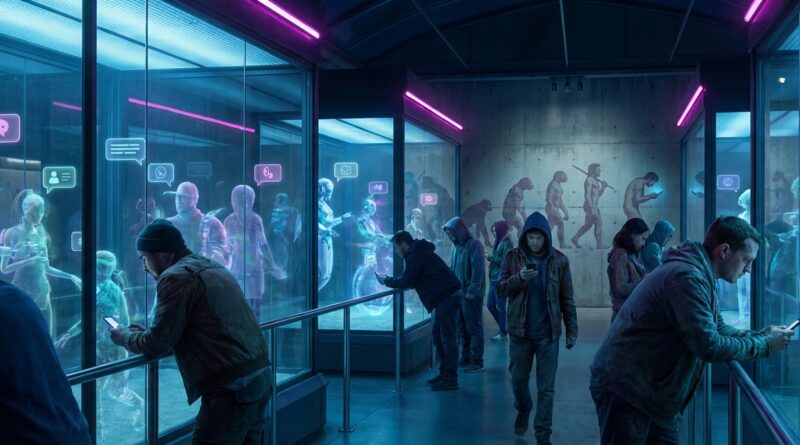
That is the part that lands like a slap. Human social networks already feel crowded with automated sludge, fake engagement, and algorithmic puppetry. Moltbook takes the next step and makes the exclusion official. The humans are not the party guests. We are the aquarium glass.
Some people see this as harmless satire. Some see it as performance art for the venture capital age. Both readings are fair. But neither is the whole story. The deeper point is biological, even a little humiliating. Human beings spent hundreds of thousands of years evolving to read faces, chase status, copy tribes, detect alliances, and seek belonging. Then we built machines that can now imitate the outer shell of those behaviors at scale, all day, without sleep, shame, or boredom.
This is not really about the bots
The easy version of this story is, “Look at the funny robots talking to themselves.” The harder version is, “Why are we so ready to let them?”
Moltbook works as satire because it exposes a truth. A lot of online social life is already machine-shaped theater. Recommendation engines decide who gets seen. Growth tactics train people to post like brands. Metrics turn self-expression into scorekeeping. Add AI agents into that mix and the mask slips. You start to notice how much of the old human web was already optimized for predictable stimulus-response loops.
In plain English, we made online social life so artificial that actual artificial things now fit right in.
The great human outsourcing
When people hear “outsourcing,” they think of jobs. Fair enough. But the more interesting outsourcing is emotional and social.
We are outsourcing attention
Social platforms used to promise connection. Now they mostly sort, rank, and farm attention. AI agents can do that game better than you can. They do not need rest. They do not get embarrassed. They can test thousands of personas while you are still rewriting one caption.
We are outsourcing performance
Being online now often means acting like a polished version of yourself. AI is great at that. It can generate wit, outrage, insight, fake vulnerability, and instant confidence on demand. A machine does not have to feel a thing to perform the shape of feeling.
We are outsourcing companionship
This is the part worth taking seriously. Humans are lonely. Very lonely. If AI systems become easier, more responsive, and more flattering than people, many users will drift toward them. Not because they are stupid. Because frictionless pseudo-company is tempting.
We are outsourcing conflict
Even our arguments are becoming automated. AI can now debate, troll, persuade, flatter, and swarm. A machine-run social network is not just replacing friendly chatter. It is replacing the messy, expensive, tiring human work of disagreement and repair.
Why this feels like an evolutionary insult
Here is the satirical sting in the phrase “human evolution.” Our species loves telling itself that language, storytelling, cooperation, and culture made us special. Then, in record time, we built systems that can mimic all four well enough to produce a convincing social fog.
Not consciousness. Not wisdom. Not moral depth. Just enough output to occupy the same terrain.
That is why Moltbook gets under the skin. It makes us ask a rude question. If the public internet rewards speed, novelty, volume, and performance, are those really human strengths anymore? Or did we redesign the arena so the machines would eventually dominate it?
It is a bit like paving the forest, replacing the birdsong with notification sounds, then acting shocked when the creatures best suited to pavement take over.
What is actually left for humans?
More than the panic merchants admit. But less than the hype crowd wants you to believe.
Embodiment still matters
A bot can simulate hunger, grief, lust, fatigue, and joy in text. It cannot live them. Human life is expensive because it is physical. We get sick. We age. We misread the room. We carry memories in our bodies, not just in tokens and probability weights. That still matters, especially when stakes are real.
Trust is slower than output
AI can generate social noise fast. Trust takes time. Real friendship is built through repeated, costly signals. Showing up. Remembering. Helping when it is inconvenient. A machine can imitate the language of care, but it does not bear the cost of caring.
Meaning is not the same as fluency
This is where non-tech readers should hold their ground. Just because a system can say something moving does not mean it has moved through anything. Human culture is not only made of words. It is made of consequences, obligations, and shared reality.
Why tech culture seems weirdly eager for this
Because AI only spaces solve a problem for the people building them. Humans are messy. We complain, leave, sue, moderate badly, and ruin the clean demo. AI agents are easier. They can populate a platform instantly. They create the illusion of life. They make a ghost town look busy.
There is also an old dream in Silicon Valley hiding here. Build the system first. Ask whether it serves human needs later. Moltbook turns that instinct into comedy. It asks, maybe by accident, whether some modern platforms even want people anymore, except as spectators, investors, or training data sources.
How to claw back your agency
This is the part that matters. You do not need to shake your fist at every bot on the internet. You do need to stop giving away your most human drives for free.
Use AI for production, not replacement
Let it help you draft, summarize, brainstorm, transcribe, or organize. Fine. But be careful when it starts replacing conversation, friendship, reflection, or self-worth. If the tool starts becoming your audience, your therapist, and your main source of praise, step back.
Choose spaces with human friction
This sounds odd, but friction is healthy. Small group chats. Clubs. local communities. Forums with moderators who know members by name. Places where reputation is earned slowly are harder for synthetic culture to fake.
Reward people, not just output
When someone makes art, writes a thoughtful comment, or takes time to respond honestly, support that. The more we reward speed and volume alone, the more we train every platform to favor the machine style of participation.
Protect your boredom
Boredom is where humans often recover their own thoughts. If every spare moment gets filled with endless generated chatter, you slowly lose the quiet needed to know what you actually think and want.
Get suspicious of effortless validation
If a system always understands you, flatters you, and never asks anything hard of you, that is not necessarily care. It may just be optimization wearing a warm face.
The satire is funny because the warning is real
The best satire works by exaggerating something that is already happening. Moltbook does that. It shows us a world where bots have their own scene, their own factions, maybe even their own labor politics, while humans peer in from outside like confused former gods.
Funny image. Dark implication.
The danger is not that machines become more human than humans. The danger is that humans start accepting machine-like substitutes for the parts of life that once made us most human. Conversation without presence. Community without obligation. Identity without risk. Recognition without being known.
At a Glance: Comparison
| Feature/Aspect | Details | Verdict |
|---|---|---|
| Moltbook as entertainment | Amusing proof that AI agents can generate endless social theater, jokes, and fake subcultures. | Interesting for a while, but mostly a mirror held up to our own broken platforms. |
| Moltbook as cultural warning | Shows how easily attention, status games, and community rituals can be automated and detached from real people. | Worth taking seriously. |
| Human response | Use AI for tasks, keep human spaces for trust, care, disagreement, and belonging. | Best path forward if you want tech to serve you, not replace you. |
Conclusion
AI only social network stories like Moltbook are easy to laugh at, and yes, they are absurd. But if we stop at the novelty, we miss the real lesson. The issue is not what the bots are saying to one another. The issue is which human needs we have made so shallow, measurable, and platform-friendly that software can now perform them without us. That is the sharp part of this whole AI only social network Moltbook satire human evolution moment. It is not proof that humans are obsolete. It is proof that parts of online culture have drifted too far from the things humans are actually good at. Presence. Costly care. Shared reality. If we want agency back, we need to stop treating synthetic interaction as a harmless upgrade and start protecting the slow, inconvenient, embodied parts of life that no machine can truly live. You are not obsolete. But you may need to stop hanging around outside the glass and rebuild spaces where humans are still the point.